


1. June - 31. October 2000

Viet Nam

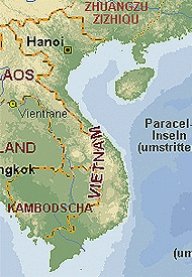
Renewal in peace - doi moi
25 years ago, in April 1975, the Vietnam war came to an end. It had moved and polarised world public opinion profoundly. The civil war with massive American intervention was at the same time a stand-off between the political blocks. The fact that Vietnam managed to assert its position against the American super power may also be explained by the strength endowed to it by its history going back over thousands of years.
The very beginnings of the state history of Vietnam are handed down and featured in many a legend and epos. About 100 years before our calendar, the kingdom of Nam Viet, which extended from the north of today's Vietnam to Da Nang, was conquered by the Chinese Han dynasty. In spite of nearly one thousand years of Chinese dominance, the Vietnam culture and above all its own language were preserved. And so Vietnamese independence was restored in 939. It was retained for nearly 900 years, until France began to conquer Indochina - Vietnam and its neighbours Cambodia and Laos - systematically in the second half of the 19th century. The Vietnamese fought against the French colonial rule from the very start. This ended in 1954 in the battle of Dien Bien Phu, with a crushing military defect for France. At the Indochina Conference in Geneva, Vietnam was divided. The USA intervened with military force in the south of the country in 1960 to prevent it being annexed by North Vietnam, which was receiving colossal support from China and the Soviet Union. In 1973, the US army had to withdraw defeated
Today, the Vietnamese policy of "doi moi", or renewal, is producing economic growth. The highly developed education system is also a motor behind the country's development. More than 80 percent of the population can read and write. Today, Vietnam is one of the world's largest rice exporting countries. And the tourism industry profits not only from Vietnam's many historical sites but also from the fabulous beaches on the long coast.