


1. June - 31. October 2000

United Kingdom

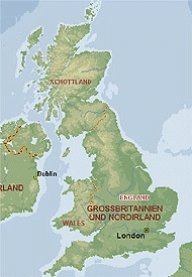
One Queen and many nations
Even the native inhabitants often simply use the term "England" or "Great Britain" when they mean the "United Kingdom of Great Britain and Northern Ireland". Yet England is only one of the countries which make up the United Kingdom. England and Wales were united in the 16th century, and were joined by Scotland in 1707. When Ireland was finally incorporated in 1801 the "the United Kingdom" was created. However, in the 20th century the greater part of Ireland reclaimed its independence.
Today the United Kingdom comprises not only Northern Ireland but also the Isle of Man and the Channel Islands. Furthermore there are some "Dependent Territories" overseas, such as the Virgin and the Falkland Islands, and Gibraltar.
Great Britain became a world empire when, in the 18th century, it replaced Spain as the dominating power on the world's oceans. The United Kingdom maintained its leading role in world politics for over two hundred years. Most of the former British colonies are today members of the Commonwealth. 17 of the 54 Commonwealth states recognise the British Queen as their head of state.
Although the British monarchy scarcely holds any political power today, it is a symbol of national unity. Queen Elisabeth II can trace her ancestors back to the year 829, when Egbert of Wessex united the warring tribes in the south of the country to form a nation.
The Scots, the Irish and the Welsh have a very marked sense of national identity. They actively promote the use of their local languages, so Gaelic and Welsh are official languages besides English. The national rugby and football teams compete against each other in international competitions.
Political decentralisation takes this patriotism into consideration. In a referendum in 1997 the Scots and the Welsh voted for the setting up of regional parliaments. "Home rule" in Northern Ireland has been deferred because of political instability there.