


1. June - 31. October 2000

Lithuania

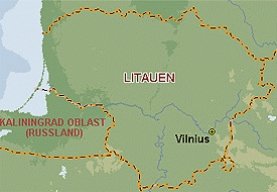
The Land of Amber on the Baltic Sea
The Baltic Republic of Lithuania has a history full of change. From the 14th to the16th century, the empire of the grand dukes of Lithuania reached to the Black Sea. By entering into a union with Poland, Lithuania became part of Roman-Catholic Western Europe. As a result of the division of Poland, the Polish-Lithuanian Empire disappeared at the end of the 18th century. Most of Lithuania came to be under Russian rule. Repeated revolts opposing making the country Russian ensued. During WW I, Lithuania was occupied by German troops and then later by the Russians. In 1921, Lithuanian independence was finally acknowledged, albeit without clearly defined borders, with the admission into the League of Nations. In 1940, this independence was lost due to the Hitler-Stalin Pact.
It was not until the Soviet Union crumbled that Lithuania once again became an independent republic in 1990. Lithuanians are the clearly the majority, making up more than 80 per cent of the country's population. The capital city is Vilnius, which means "Land of Amber". Until 1940, Lithuania was primarily an agricultural country. Under Russian rule, metal-based industries, such as the production of paper, wood and textiles were developed. Changing the economic system was very difficult, because of the strong dependence on Russia. One specific problem was the energy supply. More than 80 per cent of the energy produced in Lithuania comes from nuclear power plants, which are built just like the reactor in Tschernobyl.
Lithuania has been in negotiations since March 1999 to become part of the European Union. A co-operative council with Poland was already established in August 1997.