


1. June - 31. October 2000

Colombia

Coffee and Gold
Christopher Columbus, to whom the country owes its name, never actually set foot in Columbia. The Spanish first arrived there at the beginning of the 16th century, in the search for "El Dorado" - the man of gold. If we are to believe the legends, the Chibchas - who inhabited the area of modern day Bogotá at the time - subjected their new rulers to an unusual ritual. Covered in gold dust, they were taken out into the middle of Lake Guatavita, where they were made to offer up valuable gifts to the gods of the lake.
The Spanish conquest of Columbia began in 1525 with the founding of the town Santa Marta on the Caribbean coast. Cartagena was to become the most important Spanish port in the New World. Prior to 1717, Columbia was initially a territory belonging to the Viceroyalty of Peru, then to the Viceroyalty of New Granada. In 1819, under the leadership of Simón Bolívar, Columbia and Venezuela fought successfully together for independence, to become the Republic of Greater Columbia. Following the dissolution of that political structure, the country named itself New Granada. Since 1861, it has been known as Columbia.
Columbia's more recent history is masterfully illustrated in the novel "Cien años de soledad" (One Hundred Years of Solitude) by Gabriel García Marquez, winner of the Nobel Prize for Literature. Another famous Colombian is the artist Fernando Botero, whose paintings and sculptures are to be found in famous galleries all over the world.
Columbia remains rich in mineral resources. As well as iron ore, coal, copper, uranium and above all oil, Columbia has considerable gold and emerald reserves. On the slopes of the Andes, which run the length of the country from north to south, grows the famous Colombian coffee - at altitudes between 1,000 and 2,000 m. The milder varieties are particularly popular in the USA and western Europe.
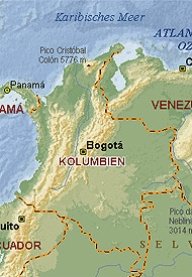
Columbia is the only country in South America to border two oceans: the Atlantic Ocean (the Caribbean) in the north, and the Pacific Ocean in the west.