


1. June - 31. October 2000

Jordan

Beyond the Jordan
In its present-day form the country "beyond the Jordan" is a 20th century creation. Transjordan was the name the British gave to the mandate, allocated to them in 1921 by the League of Nations after the collapse of the Ottoman Empire. They instated Abdullah, the brother of the Saudi Arabian Prince Faysal, as Regent. Abdullah became Jordan's first king after independence was achieved in 1946. The Hashemite dynasty traces its origins back to the great-grandfather of the prophet Mohammed. Abdullah's grandson, King Hussein, reigned from 1952 until 1999 and was the region's "oldest" head of state, in terms of years in office.
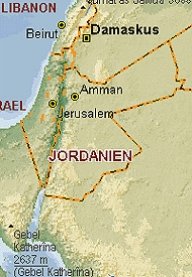
The most fertile areas of Jordan, a country which is composed of 88 percent desert, are situated in the Jordan valley. The Jordan river passes flows 156 kilometres through the country and out into the Dead Sea, which is 399 metres below sea level. It is an area steeped in history, and comprises the biblical countries of Moab, Edom and Ammon. Modern-day Amman was founded on the old capital city of Rabbath Ammon. The archaeological museum in Amman houses numerous relics dating back to the times of the Ammonite settlers.
Today the Jordan River creates the national border with Israel and Palestine. Until the conclusion of the peace treaty with Israel in 1994, it was guarded by military forces and practically impassable. The Allenby Bridge was, for many years, the only border crossing between Israel, its occupied areas and the rest of the Arab world. Jordan took in hundreds of thousands of Palestine refugees. King Hussein began at an early stage to seek a peaceful settlement of the Near East conflict, and it was he who paved the way for reconciliation between the Arab states and Israel. His son, Abdullah, continues on this course.