


1. June - 31. October 2000

Ireland

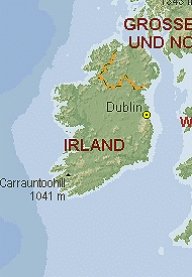
The Emerald Isle
Ireland - Gaelic: Eire - is also called the Emerald Isle. 90 per cent of its area is covered by grass and pasture. The Gulf stream brings mild winters, cool summers and lots of rain.
What counts for many as the charm of the island has also been its curse for a long time: because the wet soil is not suitable for wheat, potatoes were grown as staple food. When in the middle of the 19th century the whole crop failed due to blight, one million Irish died of hunger. Hundreds of thousands went into exile, mostly to the United States. Ireland - of Celtic origin - was christianised in the fifth century by Saint Patrick. He supposedly explained the Holy Trinity with a "Shamrock" - a three-leafed clover. St Patrick's day is the 17 March and celebrated as the National Holiday.
When England became protestant at the end of the 16th century, religious conflicts which are still alive, started with the Catholic Irish. They even play a role in The Troubles (the Northern Ireland conflict) nowadays. During more than 800 years of English rule, the Gaelic language lost some of its importance. Only in the 19th century it was revived with the Irish strive for independence. In 1921 Ireland - without Northern Ireland - was declared a free state in the Anglo-Irish Treaty and became the independent Republic of Eire in 1937. Gaelic was re-introduced as second official language besides English.
Anglo-Irish literature has produced authors of world fame, such as Oscar Wilde, Bernhard Shaw, Jonathan Swift and Samuel Beckett. With his novel "Ulysses" James Joyce created an unforgettable picture of the Irish.