


1. June - 31. October 2000

Greece

Cradle of Western culture
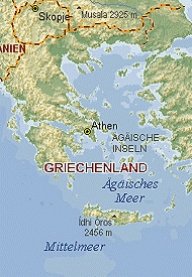
Greece, with its mountainous mainland, with Crete and the islands of the Ægean and Ionian Seas, is considered the "cradle of Western culture". The sea determines the character of the country and its people. The country's highest mountain is Mount Olympus, which is almost 3,000 metres high and was considered by the Ancient Greeks as the home of the gods.
The origin of Western culture can be traced back to the Minoans, who inhabited the island of Crete around the year 2000 BC The history of the city-states Athens, Corinth and Sparta dates back to the 7th century BC. The poet Homer passed on the story of the Trojan War in the "Iliad" and the "Odyssey". The dramas by Aristophanes, Aeschylus and Sophocles are still featured on our theatre programmes today. The works of Plato, Socrates and Aristotle form part of the basis of Western philosophy. Numerous philosophical and political terms - for example, tyranny and democracy - originate from the Greek language.
The history of modern Greece begins with the war of independence against the Turks (1821-1829), who had conquered the country in the 15th century. In 1833 Greece gained independence as a monarchy under Prince Otto I of Bavaria. The colours of the Greek flag, blue and white, can be traced back to this Bavarian prince.
In 1941 German troops occupied Greece. Immediately after liberation in 1944 civil war broke out and even when it had ended Greece continued to suffer from political unrest. In an army coup in 1967 a group of colonels claimed power. It was only in 1974 under Constantine Karamanlis that Greece became democratic again. However, restoration of the monarchy was rejected by the vast majority of the population.