


1. June - 31. October 2000

China

The Middle Kingdom
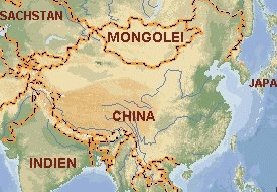
China is more than just a country: one fifth of all mankind lives on the sub-continent. The country with the largest population and third-largest state territory on earth has a unique variety of culture and agriculture.
The documented existence of civilisation is proven already for the 18th to 12th century before our calendar. Many technical and cultural innovations came from the Middle Kingdom. For example, paper and porcelain were invented in China.
The Ch'in dynasty brought state unity to China for the first time 2,200 years ago, and gave the country its name. In those days, the frontiers which more or less correspond to those of today, were protected by the Great Wall. The highly varied history of the country witnessed periods of inner decline, with domination by external powers alternating with total isolation from external influences.
Following military defeats and a phase of inner breakdown, the Republic of China was founded in 1912. During the 1930s, large stretches of land were occupied by the Japanese. The rival Communists and Republicans joined forces in an anti-Japanese front, and China entered the second world war on the side of the Allies.
Civil war raged from 1946 to 1949. The victorious Communist Party of China introduced a radical reorganisation of the country. The elimination of starvation and the expansion of the health care system count among the great successes of this period. Epidemics such as cholera, typhoid and the plague have been almost entirely eradicated, so that life expectancy has risen from 60 to more than 70 years within a period of just 20 years.
The gradual liberalisation of the economy since the 1970s has given China one of the highest growth rates in the world. Future tasks include expanding the rural infrastructure. From a political point of view, China is determined to pursue its own development path, in order to preserve national unity and take up a leading place in the international community.