


1. June - 31. October 2000

Belgium

Europe's meeting place
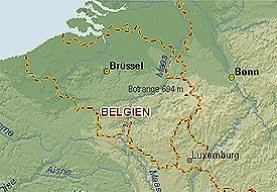
The Kingdom of Belgium unites three cultures and their languages: the Flemish north, where Flemish, a Dutch dialect, is spoken; the Walloon south, where Walloon, a French dialect, is spoken and the area east of Liège where German is the main language. The Brussels region is bi-lingual; even the street signs are written in Flemish and French. After political and cultural discord for centuries over the "language conflict", Belgium was divided up into four linguistic regions in 1970. After a further series of constitutional amendments, Belgium became the federal state, as we know it today, in 1993. Brussels, the 'secret' capital of Europe, is the seat of the EU-Commission and numerous European authorities. NATO, too, has its headquarters here. Immigrants from the former Belgian colonies in Africa add to the city's international flair. A modern-age attraction is the Atomium, which was constructed on the occasion of the World Exposition in 1958.
This year Brussels is one of Europe's thirteen "cultural capitals". Belgium's most famous painters include Peter Paul Rubens and van Dyck. Other important painters of the Flemish School are Hieronymus Bosch, Peter Bruegel and Jan van Eyck. In the 20th century James Ensor, Paul Delvaux and René Magritte attained world fame.
Flanders was one of the world's leading trade centres in the Middle Ages. Well-preserved town centres such as those of Ghent or Bruges bear witness to this. Antwerp was a leading port already in the 16th century. Today, it is a trade centre for diamonds, with over half of the world diamond trade taking place there.
The Walloon south was shaped by the coal mining and steel industries, and is still feeling the economic after-effects of the structural crisis in these sectors.