


1. June - 31. October 2000

Ethiopia

Proud and independent
Ethiopia is the one African country never to have been colonized. Its Imperial Family was regarded as the oldest one in the world. Haile Selassi, who was overthrown in 1974, came from a dynasty which, according to legend, was founded by Menelik I in the 10th century BC He is supposed to be a direct descendant of King Solomon and Queen Sheba.
The Semites, who in pre-Christian time entered the country from southern Arabia, called it Abyssinia - a mixture of people. They are thought to have founded the realm of Aksum. Through trading with the Romans and Greeks, they came into contact with the Christian Faith which was officially recognized in the year 330 AD. Aksum became the most important trading power on the Red Sea.
The building of the Suez Canal in the 19th century gave the Horn of Africa greater strategic meaning for the colonial and other great powers. Ethiopia, however, was always able to defend its independence. Only the coastal strip along the Mediterranean was occupied by the Italians and became the colony of Eritrea.
Unrest after a famine in 1974 led to Emperor Haile Selassi being overthrown. Twenty years later, a federal constitution was passed, which acknowledged the country's ethnic-cultural diversity.
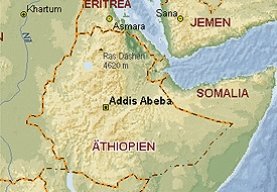
Ethiopia's countryside is defined by its position along the East African rift valley. This rift - created by continental drift - divides the country into areas which are farmed in totally different ways depending on altitude and rain frequency. The main settlement area "Woina Dega" lies between 1,600 and 2,500 meters high and has a temperate climate. Grains, cotton and the famous Ethiopian coffee are grown there. The famine, which affects Ethiopia every so often, is normally restricted to a particular area.